Sinhala, Tamil, Moor, Malay and Burgher; Buddhist, Hindu, Muslim and Christian — on an island small enough that the festivals overlap. Almost nothing here is staged for visitors, which is exactly why you should ask before you photograph it.
In practice
What is happening this week.
These are not performances laid on for a season. They are a religious calendar, a working craft economy and a set of household rituals that happen whether or not anyone is watching.
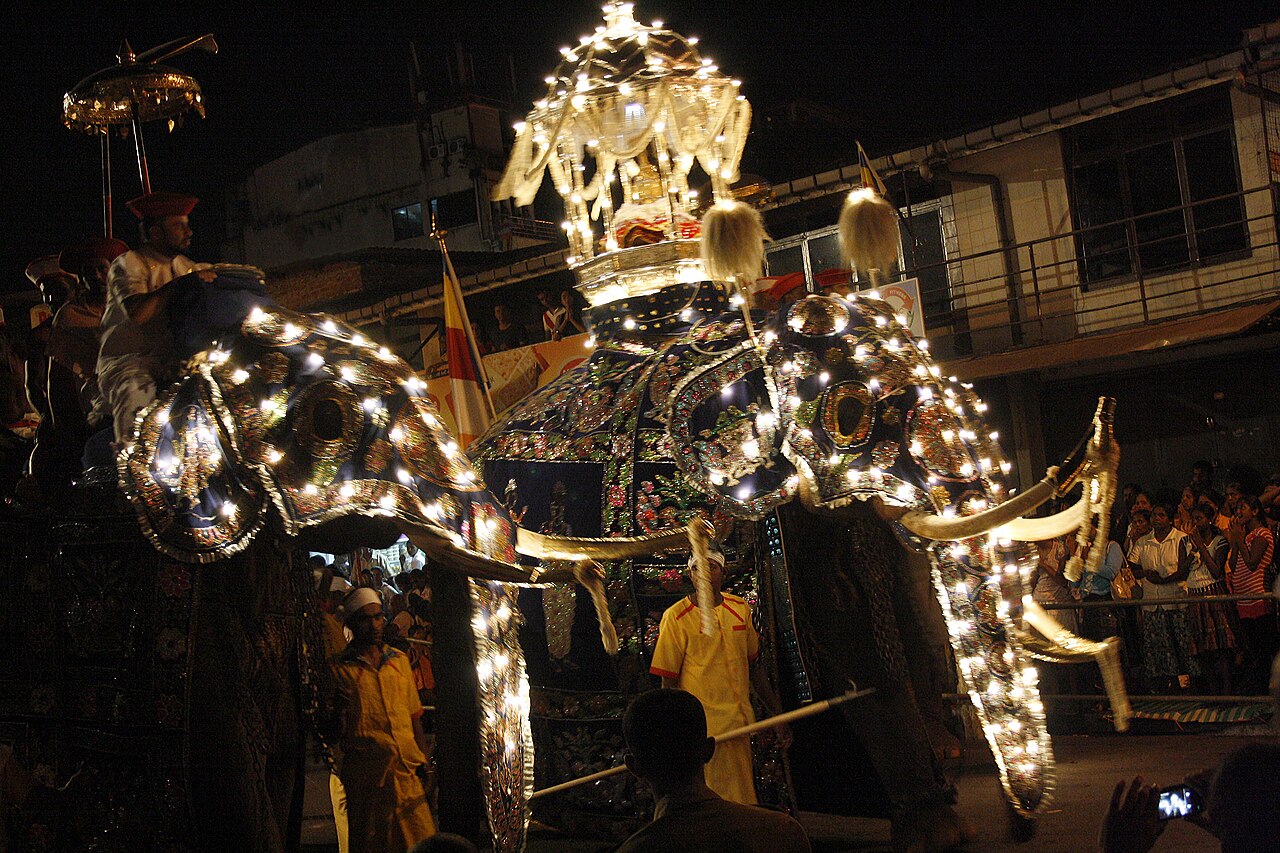
Perahera night, Kandy
Kandy · Esala full moon, Jul–Aug
Esala Perahera ඇසළ පෙරහැර
Ten nights of processions through Kandy: whip-crackers clearing the road, fire dancers, ranks of Kandyan drummers, and finally the Maligawa tusker in full regalia carrying a casket that stands in for the Sacred Tooth Relic. Book a balcony seat weeks out, or sit on the kerb by four in the afternoon and wait.
Free on the street · the last night is the biggest
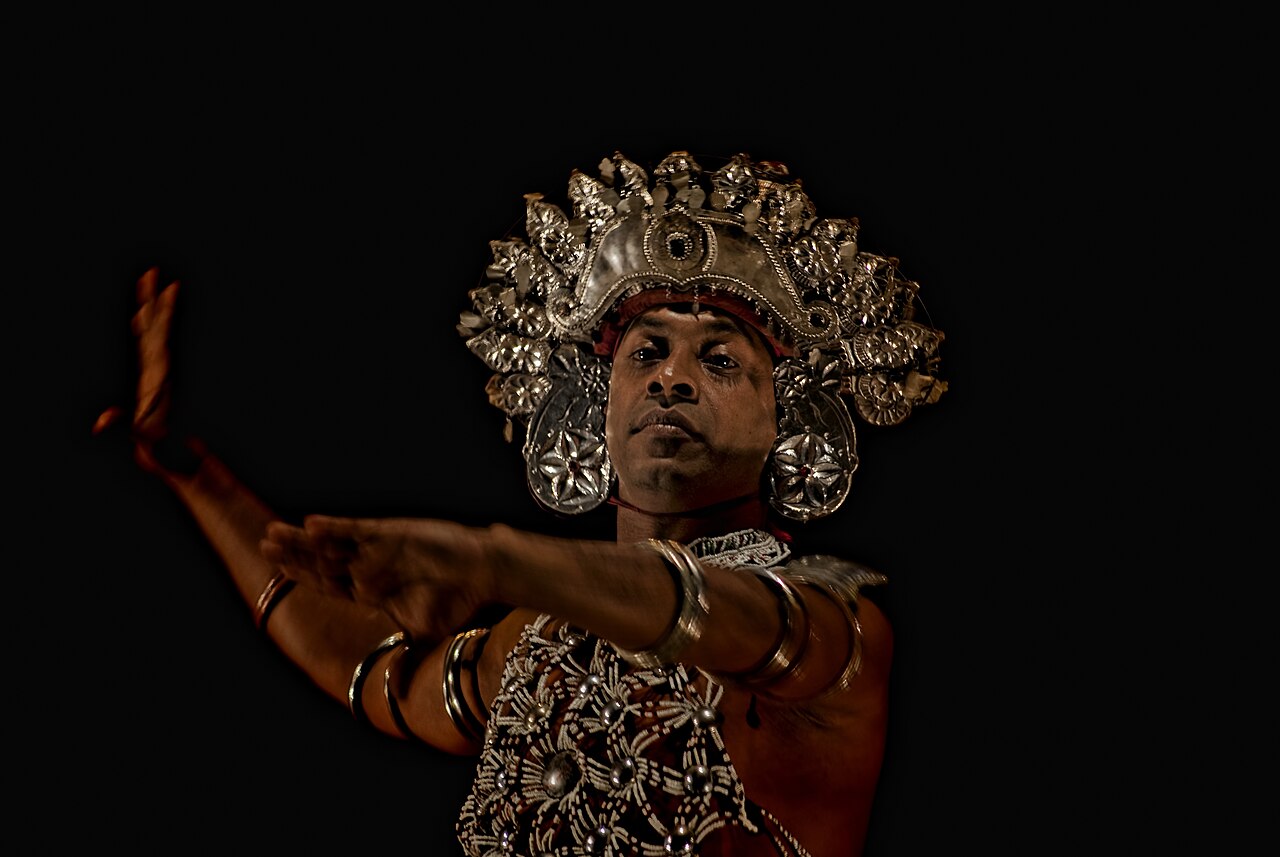
Kandyan dancers, up-country style
Up-country
Geta beraya ගැට බෙරය
The double-headed Kandyan drum, one face tuned treble and one bass, played with both hands and read like language: the drummer speaks a syllabic pattern before the dancer moves. If you see one performance, make it a temple puja rather than a hotel floor show.
Kandy nightly · ask for a puja time instead
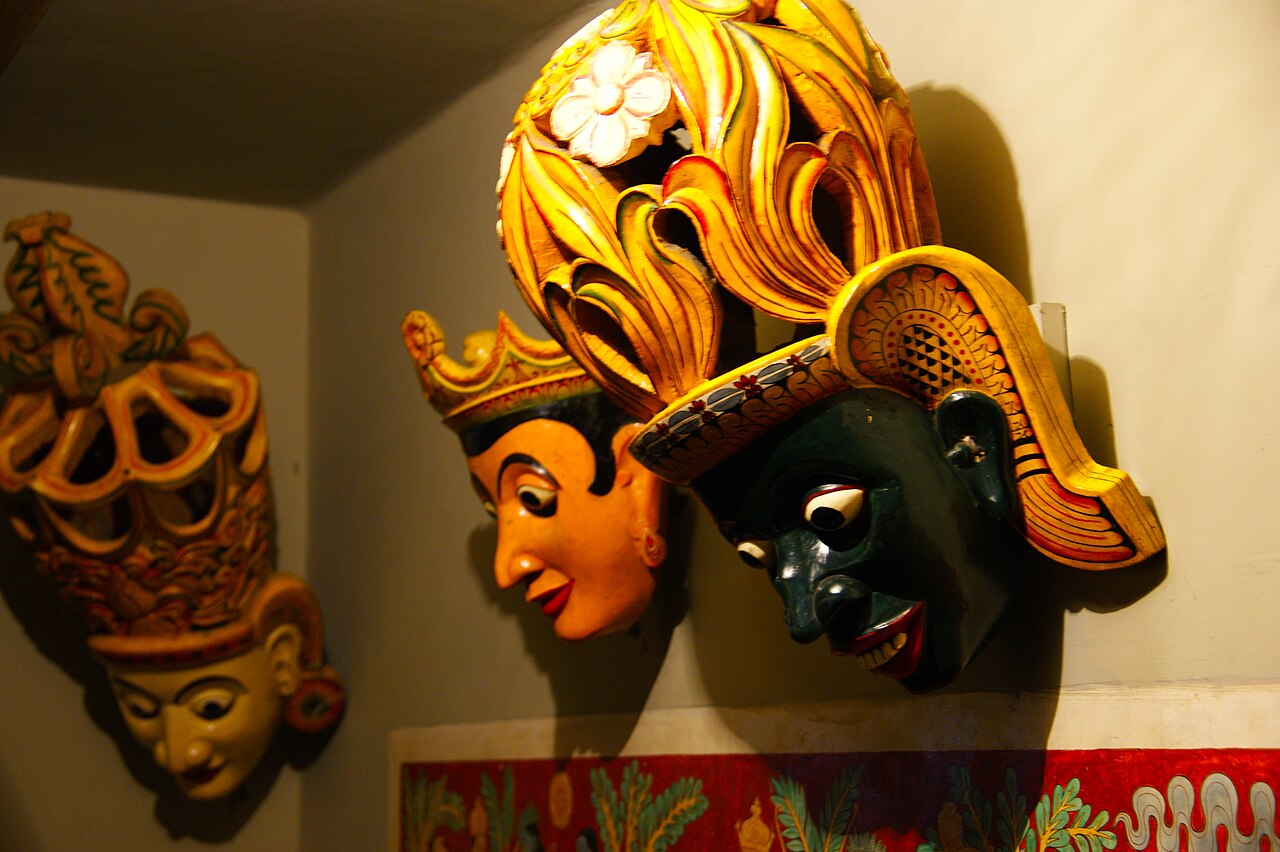
Carved masks, Ambalangoda
Ambalangoda · south coast
Masks and the healing plays වෙස් මුහුණු
Kolam masks satirise the village and the colonial court; the eighteen sanni masks each carry a named affliction and are worn through the night in a ritual meant to argue an illness out of a patient. Carved from soft kaduru wood, painted in the same ochres as the temple walls.
Two working mask museums · carvers on site
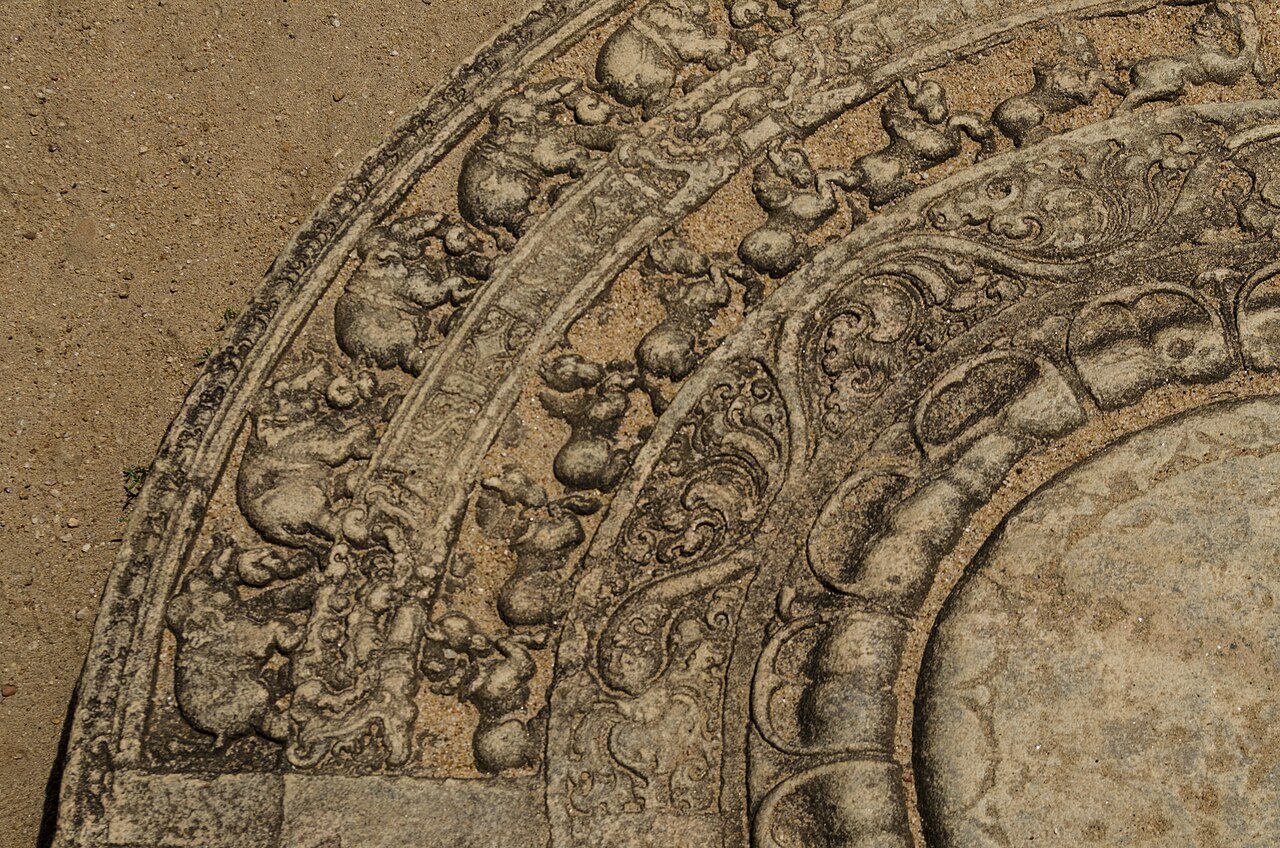
A moonstone at the threshold
Every temple staircase
Sandakada pahana සඳකඩ පහණ
The carved half-moon at the foot of the steps, read from the outside in: flames, then a procession of elephant, horse, lion and bull, then the liya vela creeper, then swans, then the lotus at the centre. Step across it, never on it — it is the threshold itself, not decoration.
Finest examples: Anuradhapura, Biso Maligaya
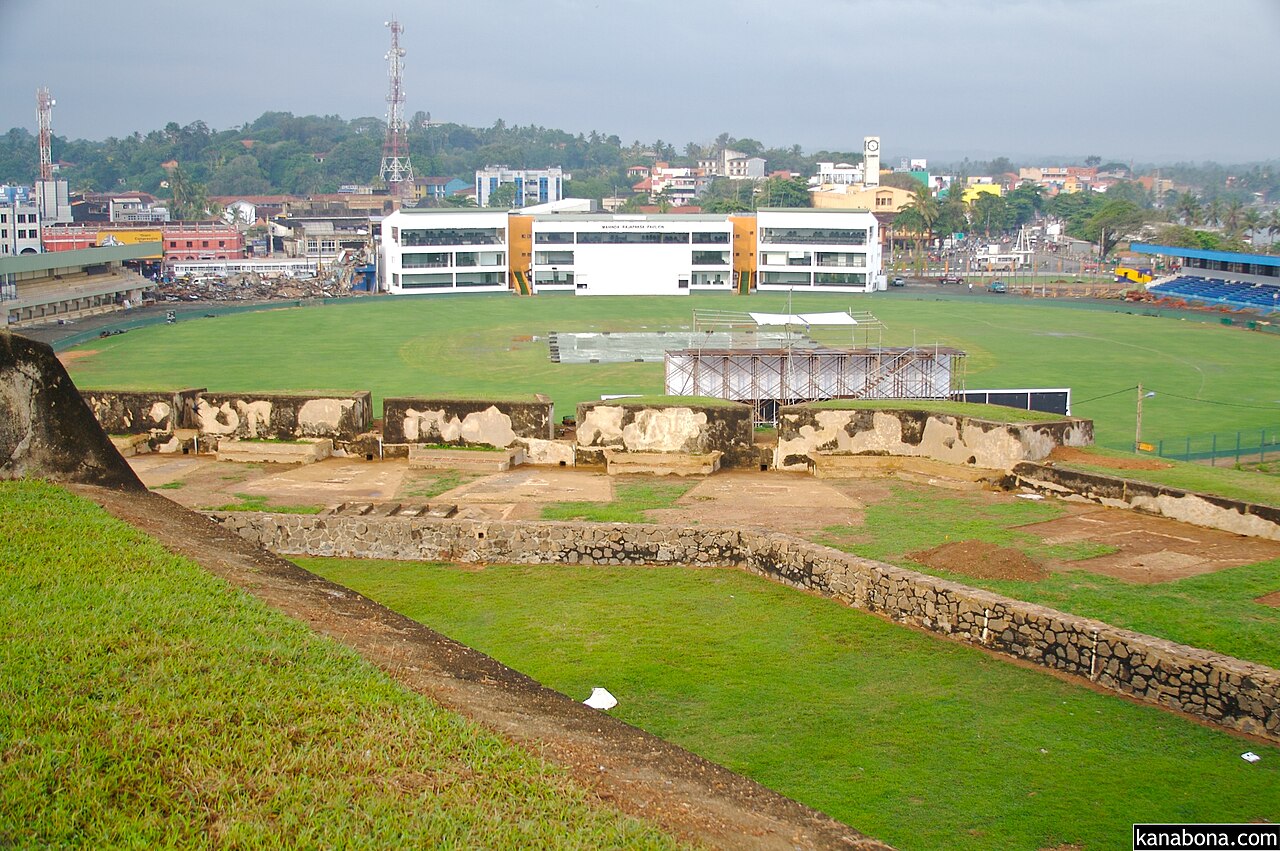
The Galle ground, from the fort ramparts
Everywhere · always
Cricket ක්රිකට්
The national obsession, played on every strip of flat ground and murmuring from every shop radio. If a Test is on at Galle, watch it the way the town does — free, from the fort ramparts above the ground, wandering off for lunch and back for the next wicket. The 1996 World Cup is still spoken of in the present tense.
Galle Tests usually early in the year · the rampart is the grandstand
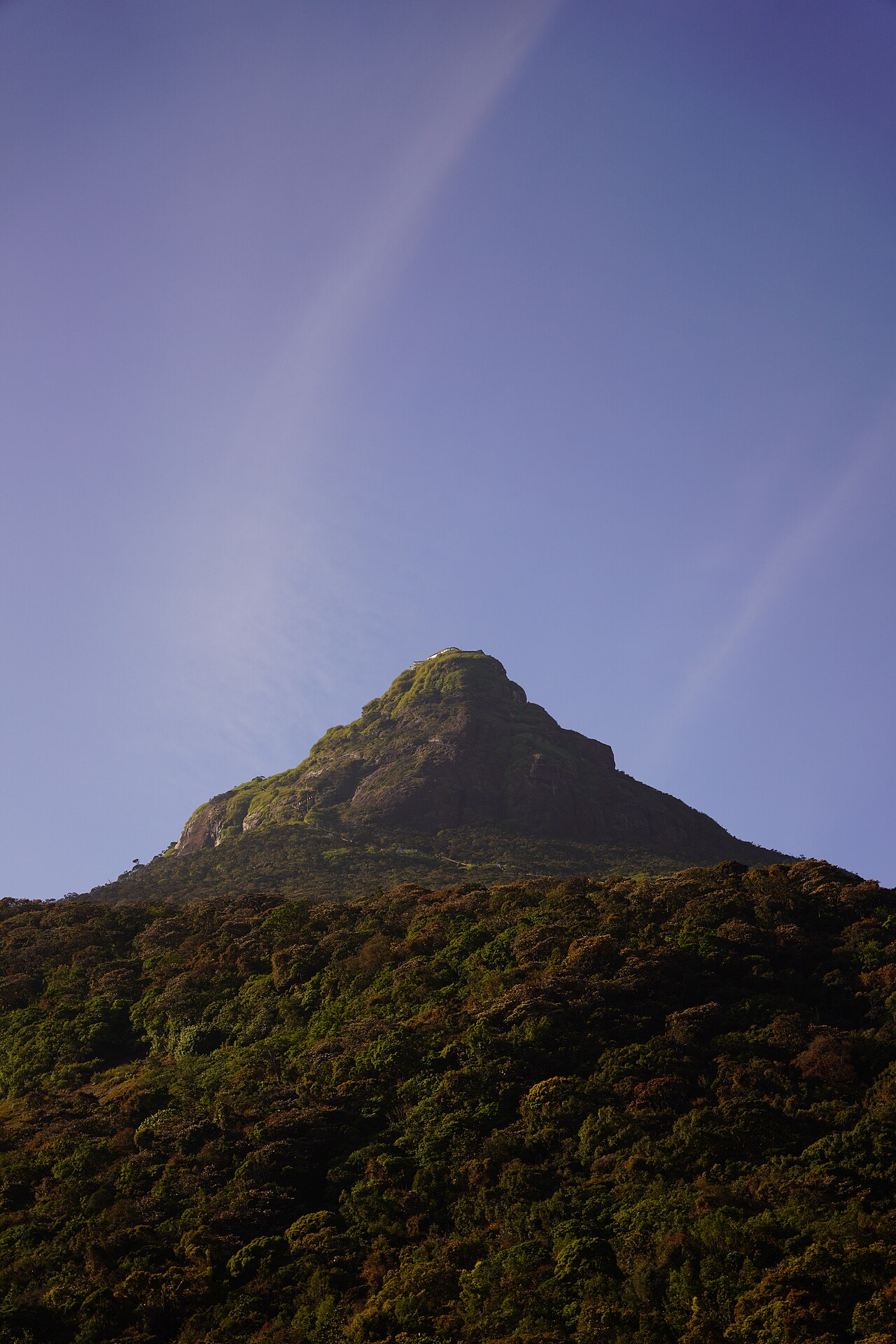
Sri Pada, the holy mountain
Hill country · season Dec–May
The pilgrimage ශ්රී පාද
Adam’s Peak — Sri Pada, the sacred footprint — is climbed at night, up some five and a half thousand lamplit steps, to stand in the cold and watch the sun throw the mountain’s perfect triangular shadow across the clouds. Buddhists say the print at the summit is the Buddha’s, Hindus say Shiva’s, Muslims and some Christians say Adam’s first step out of Eden — and all of them climb together, grandmothers included. In season the steps are lit and lined with tea stalls the whole way up.
Start around 2 am from the Hatton side · out of season the mountain is dark and empty — see the hill-country route
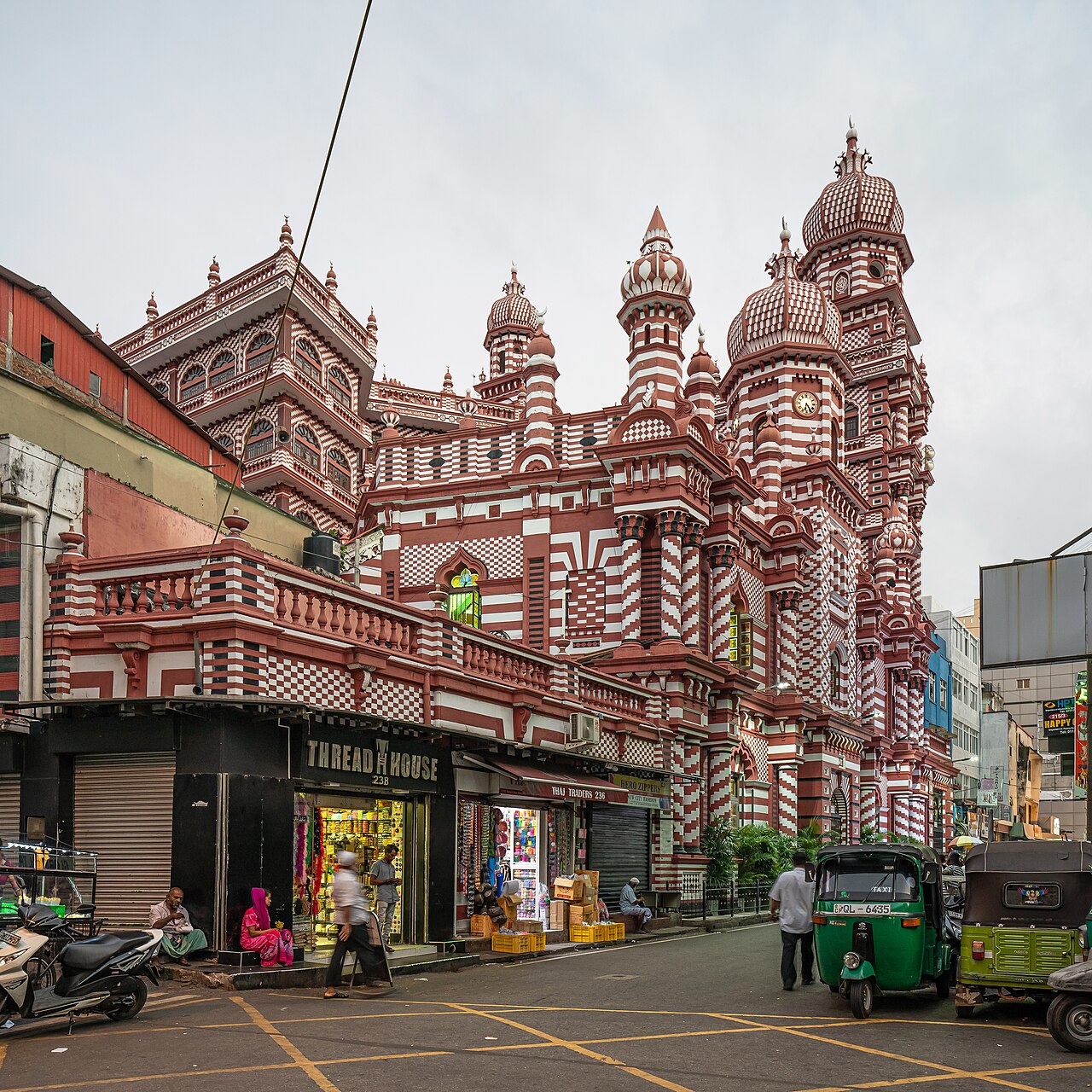
Jami Ul-Alfar mosque, Pettah
Colombo & the coast
Four faiths, one street
A Buddhist temple, a Hindu kovil, the red-and-white striped Jami Ul-Alfar mosque and a Portuguese-descended Catholic church can sit within a few blocks of each other in Colombo, and their festivals land in the same calendar. Almost every major religious holiday here is a public holiday for everyone.
Pettah, Colombo · walk it in a morning
Built in brick and granite
Two thousand years of building.
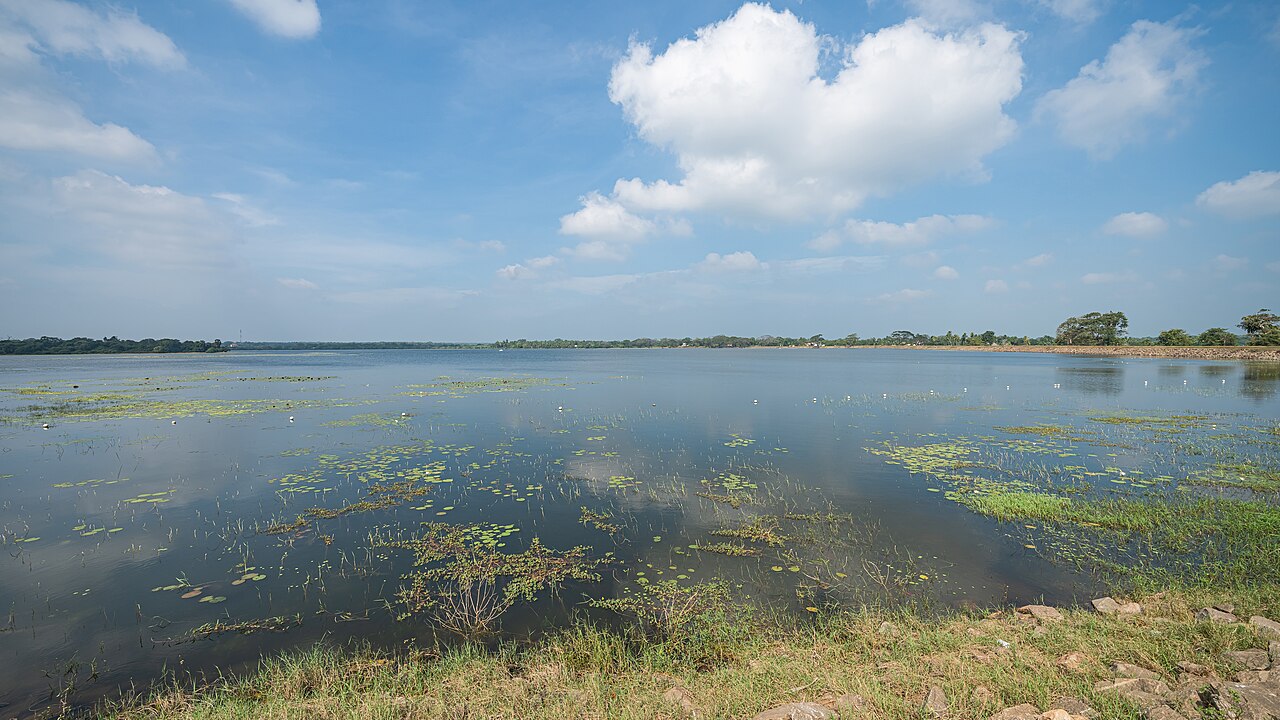
The dry-zone capitals were engineering projects as much as religious ones: vast reservoirs feeding cities feeding monasteries. The irrigation works still function, which is the part that should impress you.
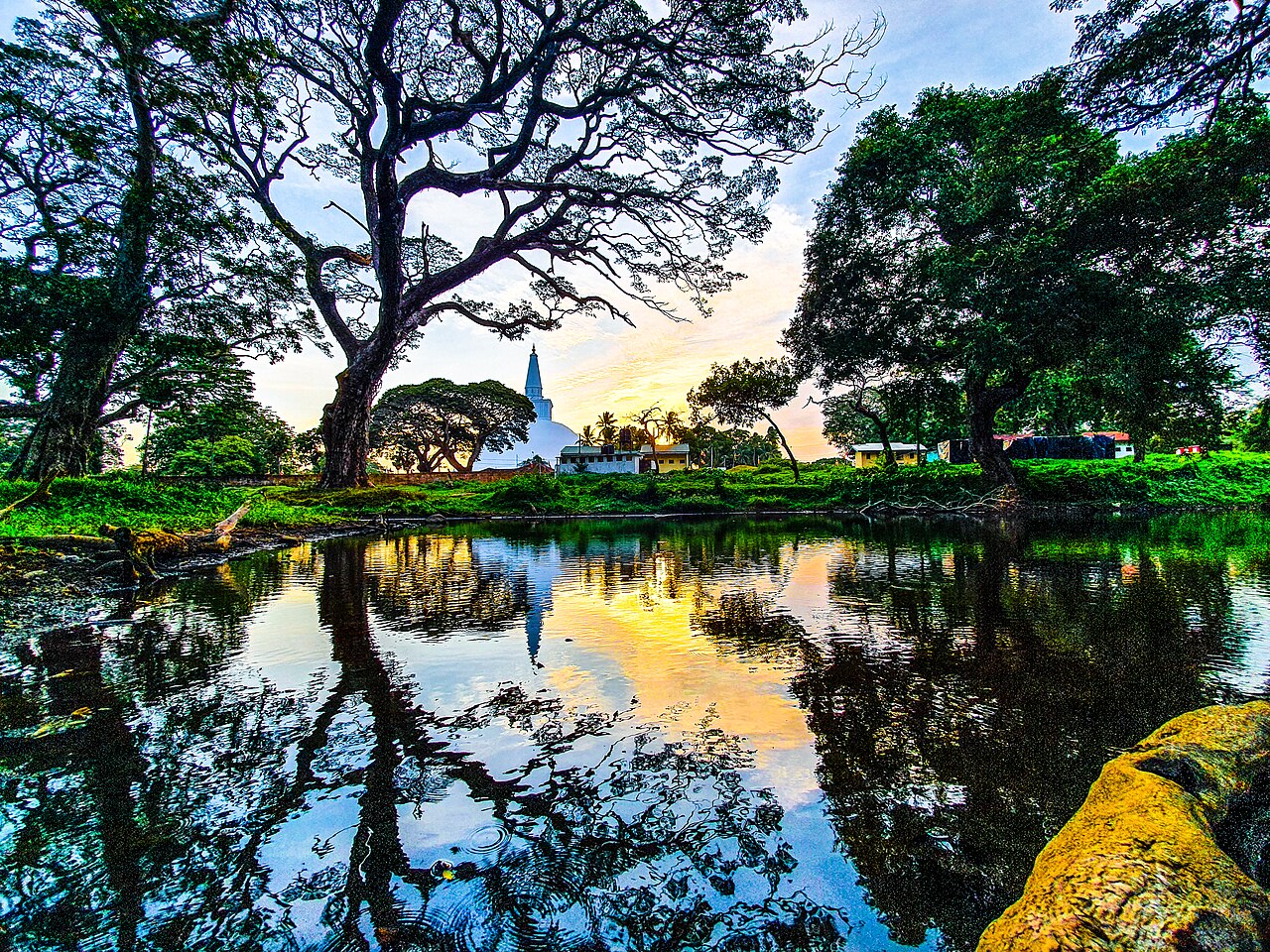
Ruwanweli Maha Seya, Anuradhapura
4th c. BC – 11th c. AD
Anuradhapura අනුරාධපුර
A capital for over a thousand years and still a working pilgrimage city. Brick dagobas the size of small pyramids, monastery precincts spread over kilometres of parkland, and the Sri Maha Bodhi — grown from a cutting of the tree the Buddha sat under, tended continuously since the third century BC.
Go in white · barefoot on the sacred terraces
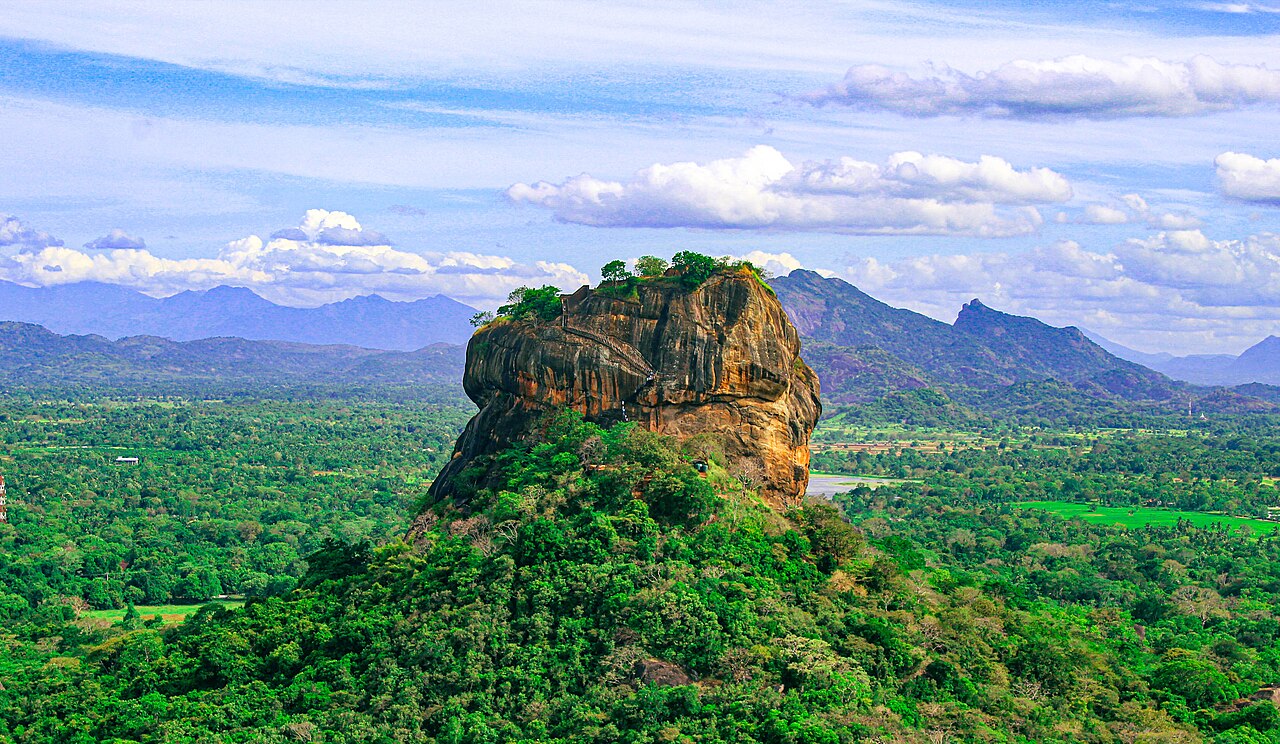
Sigiriya, the lion rock
5th century
Sigiriya සීගිරිය
A palace on top of a magma plug, reached past a mirror wall polished enough to reflect and a gallery of frescoed women painted into a sheltered pocket of rock. Kasyapa built it after taking the throne from his father; it lasted eighteen years and then became a monastery for eight centuries.
Climb at opening · Pidurangala for the view back
Tank and ruin, the dry-zone capitals
11th–13th century
Polonnaruwa පොළොන්නරුව
The second capital, compact enough to ride around in a morning, and the place where the sandakada pahana starts dropping the bull from its animal band. End at Gal Vihara: four colossal Buddhas cut from a single granite face, the reclining one fourteen metres long.
Hire a bicycle at the gate · half a day
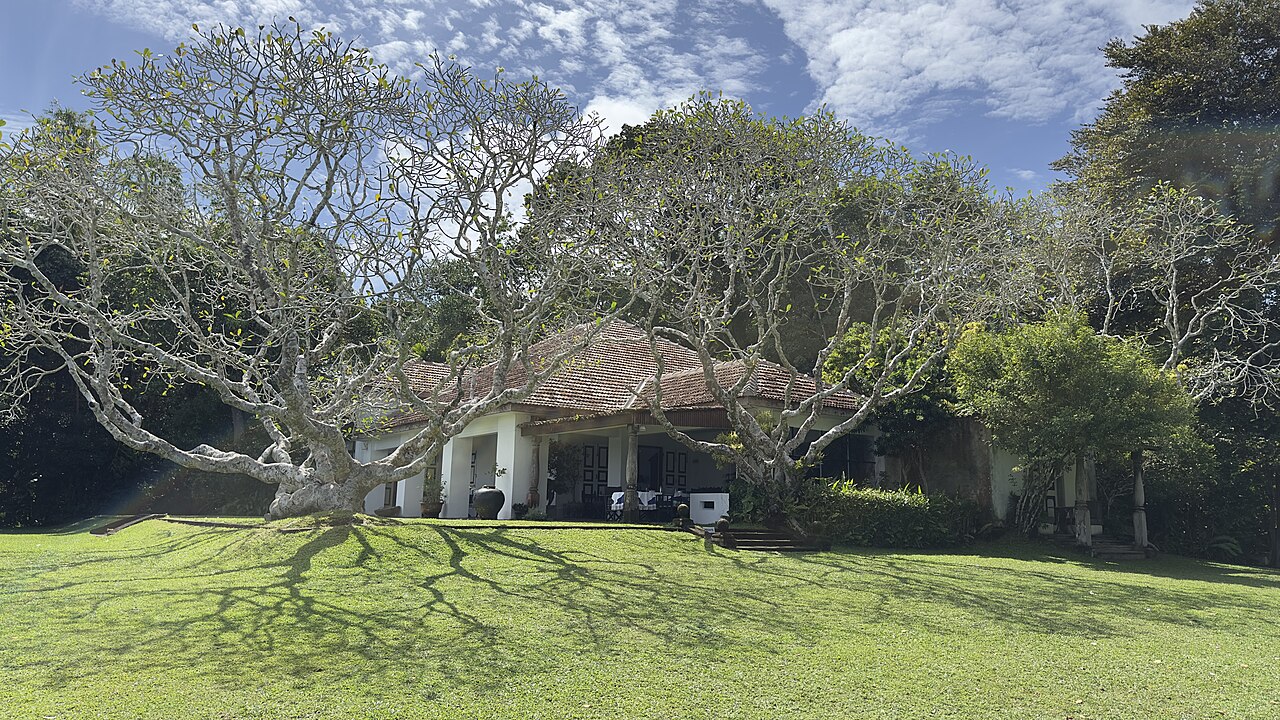
Lunuganga, Bawa’s garden at Bentota
20th century
Geoffrey Bawa
The building did not stop with the kingdoms. Bawa, a lawyer who came to architecture at 38, invented what the world now calls tropical modernism: buildings that give up fighting the climate and open themselves to it — courtyards inside houses, corridors that are verandahs, a parliament floating on a lake. His own two homes are the way in: Lunuganga, a garden estate near Bentota shaped over fifty years, and Number 11, his Colombo townhouse, both open to visitors. Half the good hotels on the island are quoting him.
Lunuganga & Number 11 tours run daily · book ahead
The leaf
Tea, and how it got here.
The hills were coffee until a leaf rust arrived in 1869 and killed the entire industry in a generation. A Scottish planter named James Taylor had put in nineteen experimental acres of tea at Loolecondera two years earlier — and by the time the coffee was dead, Ceylon tea had a name it has never lost.
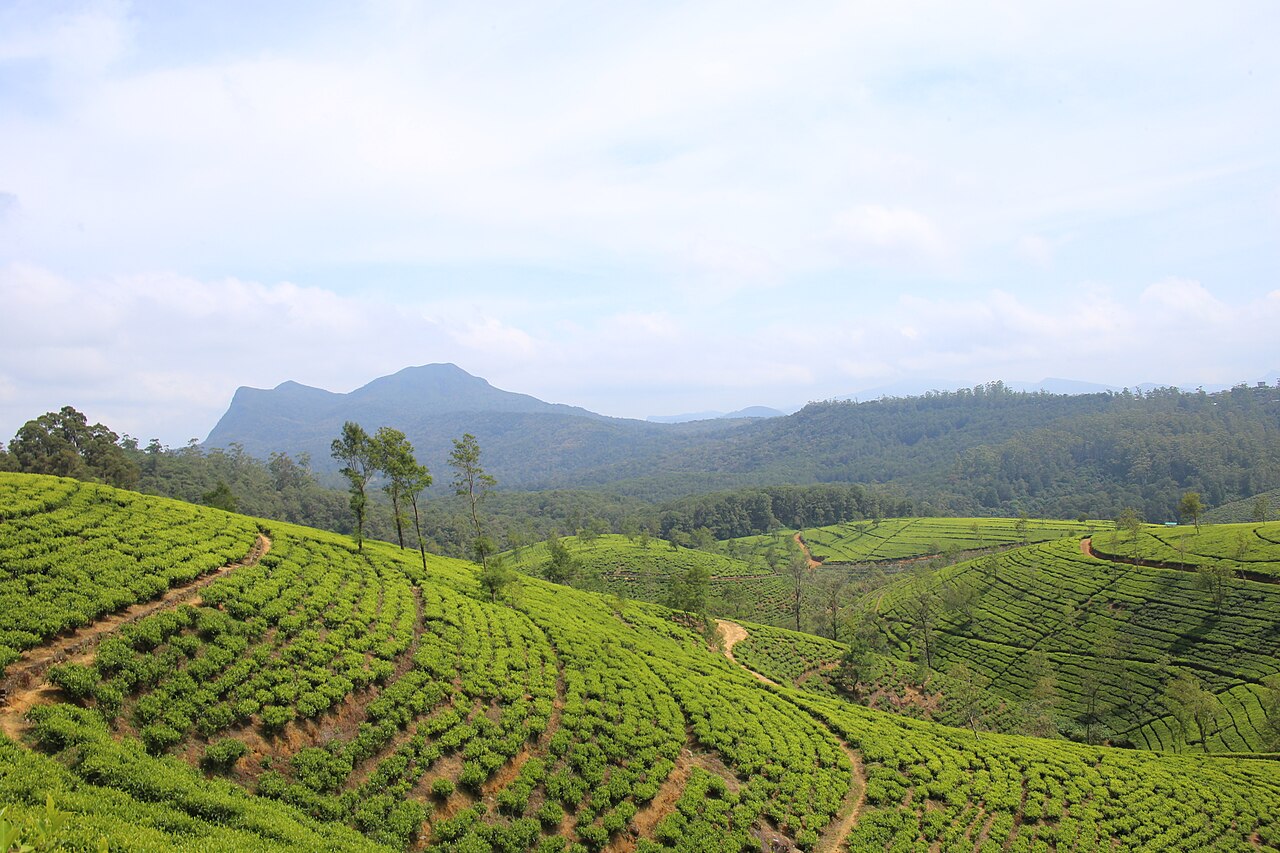
Tea country, near Nuwara Eliya
The landscape
What the hills are wearing
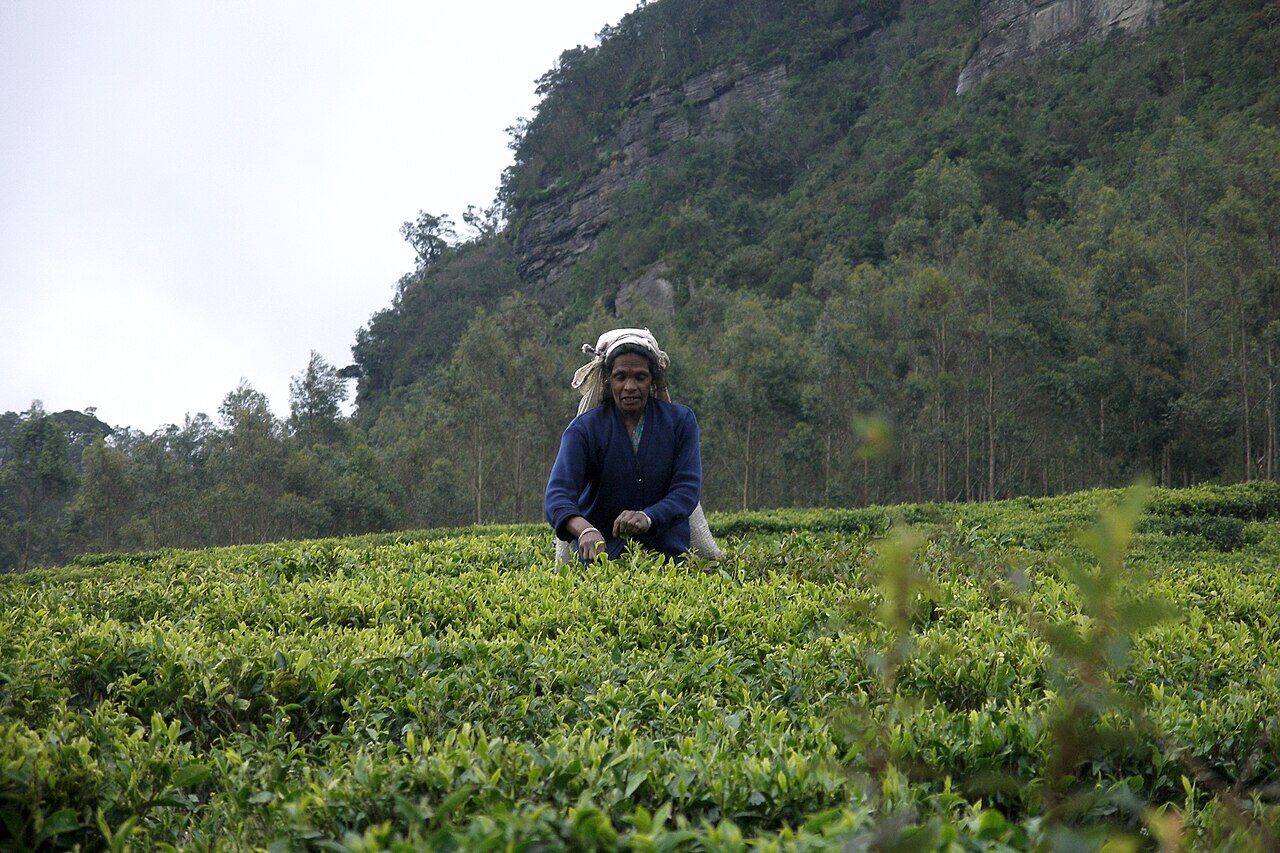
Everything you photograph from the Ella train — the clipped green terraces, the white factory buildings with their louvred sides, the lines of shade trees — is a working industry, not a park. The bushes are pruned to a plucking table at waist height and kept there for decades; some of the bushes being picked today were planted under Queen Victoria.
Tea is still picked by hand — two leaves and a bud, around eighteen kilos a day — almost entirely by Malaiyaha Tamil women, descendants of workers brought from South India by the British in the 1800s. They remain among the island’s poorest communities and were only granted full citizenship in 2003. Worth knowing before you photograph the picturesque part.
Ask first, and tip the person, not the estate
The process
Visiting a factory
Working factories around Ella, Haputale and Nuwara Eliya run short tours: withering lofts upstairs, then rolling, oxidising, firing and grading below, all on machinery whose design has barely changed in a century. Go in the morning when the line is actually running, and taste the grades at the end — then argue about elevation over the cups.
Morning for the machines · the smell alone is worth it
On foot
The Pekoe Trail
A 300-kilometre walking route in 22 stages, opened in 2023, threading the old estate paths between Kandy, Hatton, Haputale and Ella. You do not walk all of it; you pick a stage — the ones around Haputale and Ella are the most accessible — and spend a day crossing tea country at the speed it deserves.
Any stage is a day walk · start early, cloud comes at noon
The calendar
A year of public holidays.
Sri Lanka has one of the longest public holiday calendars in the world, because it observes the major dates of four religions plus every full moon. Plan around it and you get spectacle; ignore it and you get closed banks.
When
What
Notes
Every full moon
Poya පොහොය
Public holiday. Temples full, bars shut, no alcohol sold.
January
Duruthu Poya · Thai Pongal
Tamil harvest festival; kiribath and boiling milk at dawn.
February
Navam Perahera · Independence Day
Colombo’s big procession from Gangaramaya, 4 February parades.
March–April
Maha Sivarathri · Good Friday
Kovils open through the night at Sivarathri.
13–14 April
Aluth Avurudda අලුත් අවුරුද්ද
Sinhala and Tamil New Year. The island stops. Games, oil lamps, sweets, and no transport.
May
Vesak වෙසක්
The Buddha’s birth, enlightenment and death. Paper lanterns everywhere and free food stalls, dansal, on the roadside.
June
Poson
Marks the arrival of Buddhism; Mihintale and Anuradhapura fill up.
July–August
Esala Perahera · Kataragama · Nallur
The three biggest processions, Buddhist, syncretic and Hindu, all at once.
Varies
Ramadan, Eid, Deepavali, Christmas
All public holidays. The calendar is genuinely shared.
Made by hand
What is still being made.
Buying directly from a workshop rather than a hotel gift shop is the difference between a craft surviving and a craft being remembered.
Ambalangoda
Mask carving
Kaduru wood, smoke-dried for a week, carved and painted by hand. Kolam, sanni and raksha masks are three different traditions, not three styles of souvenir.
Dumbara valley
Hana mats
Woven from hemp fibre by a single community of weavers, with geometric bands that read like the temple friezes. Slow, expensive and worth it.
Galle & the south
Beeralu lace
Bobbin lace left behind by the Portuguese and kept alive by women along the southern coast.
Kandy & Pilimatalawa
Brass and silver
Repoussé trays, oil lamps and the sixty-four traditional crafts still taught around the old royal workshops.
Everywhere
Batik
Introduced in the twentieth century and now unmistakably local. Look for hand-drawn work rather than stamped.
Ratnapura
Gems
The island has been a gem source since antiquity. Buy from a licensed dealer with a certificate, or enjoy the mines and buy nothing.
A short history
Twenty-five centuries, briefly.
Enough of the story to make the ruins, the forts, the tea and the map make sense. Whole shelves exist on each row.
When
What
What it left behind
5th c. BC
The chronicles open with Prince Vijaya’s landing
The Sinhala people — though the Vedda were here first, and still are
3rd c. BC
Mahinda brings Buddhism to the king at Mihintale
Anuradhapura, capital for twelve centuries, and the Sri Maha Bodhi
993
The Chola empire takes the north
The move south: Polonnaruwa becomes the second capital
12th c.
Parakramabahu I — “let not even one drop of rain flow to the sea unused”
The great tanks, still irrigating the dry zone
1505
The Portuguese arrive chasing cinnamon
Catholic coasts, surnames, and beeralu lace
1658
The Dutch push them out and run the coasts
Galle Fort, Roman-Dutch law, and the Burgher community
1815
Kandy, the last kingdom, falls to the British
The whole island under one foreign flag for the only time
1869
Coffee rust kills the plantation economy
Tea — and the Malaiyaha Tamil communities who pick it
1948
Independence, as Ceylon
A republic renamed Sri Lanka in 1972
1983–2009
Civil war between the state and the LTTE
Fought mostly in the north and east; ended in 2009
Since
Peace, a hard economic crisis in 2022, recovery
Tourism back as a mainstay — which is where you come in
The war is within living memory for everyone you will meet, and how the story is told depends on who is telling it. Travel the north with curiosity rather than conclusions, and let people raise it first.
At a temple
Four rules that matter.
Sri Lankans are relaxed about most things and immovable about these.
Dress
Shoulders and knees covered
White is traditional at a temple but not required. Shoes and hats come off at the gate; there is always somewhere to leave them.
Photographs
Never with your back to a Buddha
Posing in front of an image with your back to it is a serious offence here, and people have been prosecuted and deported for it. Ask before photographing monks or worshippers.
Tattoos
Think twice about Buddha imagery
Visitors have been refused entry and removed from the country over Buddha tattoos and T-shirts. Cover them.
The moonstone
Step over, not on
It marks the threshold. Walking across a carved sandakada pahana reads roughly the way standing on an altar would.