It is a plate of rice with five to fifteen small things around it, each cooked a different way, meant to be mixed a little at a time with your right hand. Everything else on this page is either what you eat before it, after it, or instead of it at eleven at night.
Anatomy
How to read a plate.
The bowls arrive together and are refilled without being asked. Take a little of each onto the rice in front of you, mix with your fingertips, and go back for the ones you liked.
The plate
Tap any bowl to see what is usually in it. A rice and curry is built around one starch and five to fifteen small dishes, each cooked a different way — something sour, something dry, something soupy, something raw, and at least one thing hotter than you expect.
Through the day
From dawn to the last griddle.
The island eats rice three times a day if it can, and works an extraordinary number of other things around it.
Before seven
Hoppers and string hoppers ආප්ප
A hopper is a bowl-shaped pancake of fermented rice batter and coconut milk, cooked in a small curved pan so the middle stays soft and the rim goes to lace. Order an egg hopper and eat it with lunu miris. String hoppers are steamed rice-flour nests, eaten with a thin coconut gravy called kiri hodi and a sambol.
Hopper stalls open at dusk as well as at dawn
Breakfast & celebration
Kiribath කිරිබත්
Rice cooked in thick coconut milk, pressed flat and cut into diamonds. It is the first thing eaten on New Year’s morning, on the first of the month, and at the start of anything that matters. Served with lunu miris or jaggery.
Sweet or fiery — both are correct
Kottu on the griddle, after dark
After dark
Kottu කොත්තු
Godamba roti chopped on a steel griddle with vegetables, egg and whatever meat you ask for, to a two-blade rhythm you can hear from the end of the street. It is the sound of a Sri Lankan evening. Cheese kottu is a modern heresy that has entirely won.
Follow the noise · ask for it less spicy once
Any hour
Short eats
The glass case on every bakery counter: fish buns, Chinese rolls (breadcrumbed, not spring rolls), isso vade with a whole prawn pressed into a lentil cake, cutlets, seeni sambol buns. You take a plate, help yourself, and are charged for what you ate.
The bakery tuk-tuk plays Für Elise — that is bread
The good stuff
Curries worth hunting
Polos, young jackfruit cooked dark and meaty. Ambul thiyal, fish dried down with goraka until it is sour and almost black. Black pork curry, roasted spice and deep colour. Crab curry on the coast, and jaffna-style with a hotter, more roasted masala. Kool, the Jaffna seafood broth thickened with palmyrah flour.
Ask what the kade cooked today rather than reading a menu
The roadside fruit stall
Between meals
The fruit stall පළතුරු
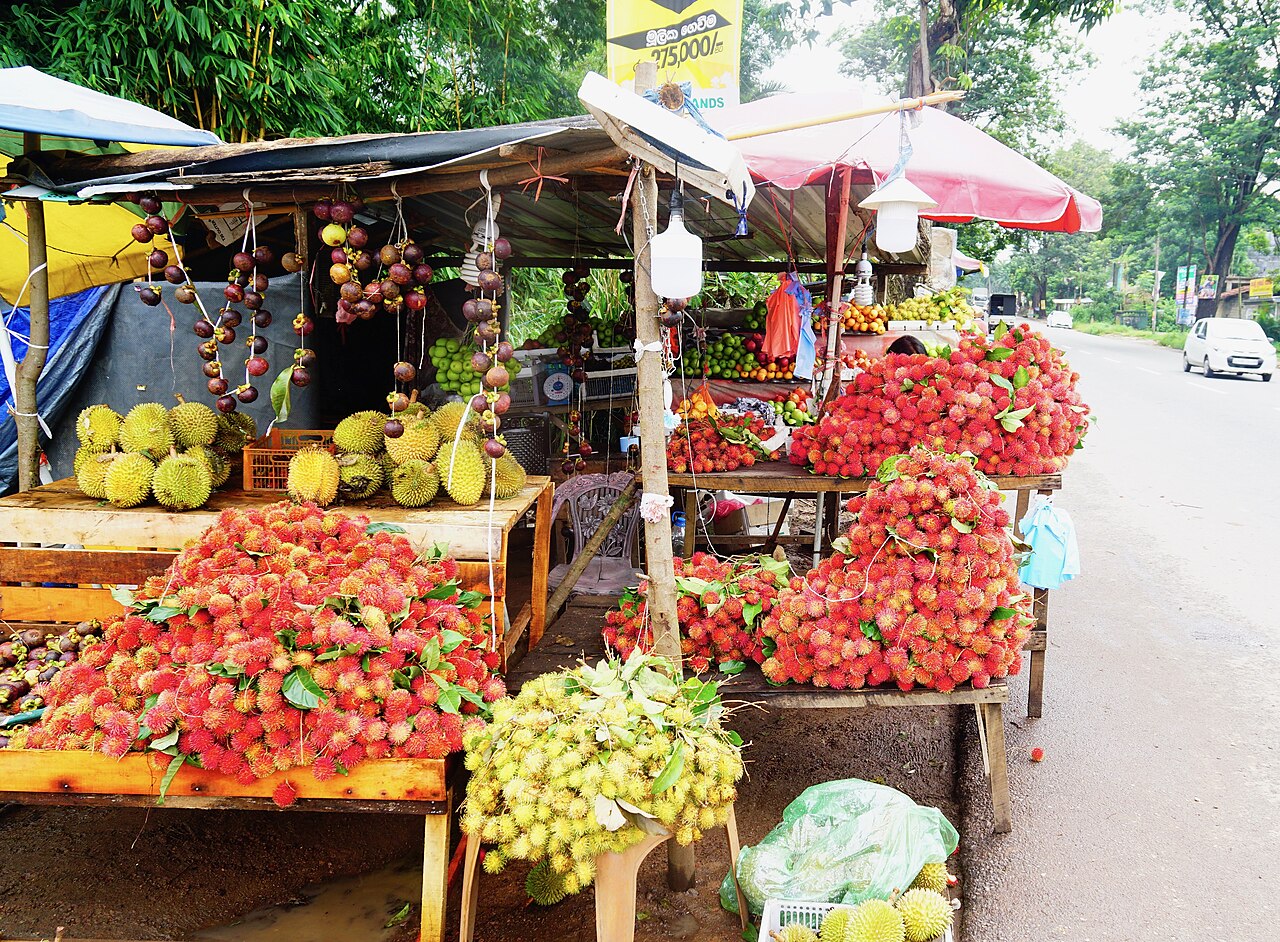
Pull over for it. Green mango sliced and shaken with chilli and salt, rambutan by the kilo in the middle of the year, mangosteen, a dozen kinds of banana that never leave the island, and wood apple — which smells like an argument and makes the best juice you will meet. Papaya with lime for breakfast forever.
Whatever is in a heap by the road is what is in season
After
Curd, treacle and the sweet shelf කිතුල් පැණි
Buffalo curd in a clay pot with kithul treacle poured over it — the best dessert on the island and usually the cheapest. Then wattalappam, a Malay-descended jaggery and coconut custard, and the New Year sweets: kokis, aluwa, kevum, aggala.
Clay pot, not plastic · the treacle should be dark
The spice island
Cinnamon was the whole point.
Three European empires fought over this island for four centuries, and the prize was bark. Everything on the plate above stands on the spice rack below.
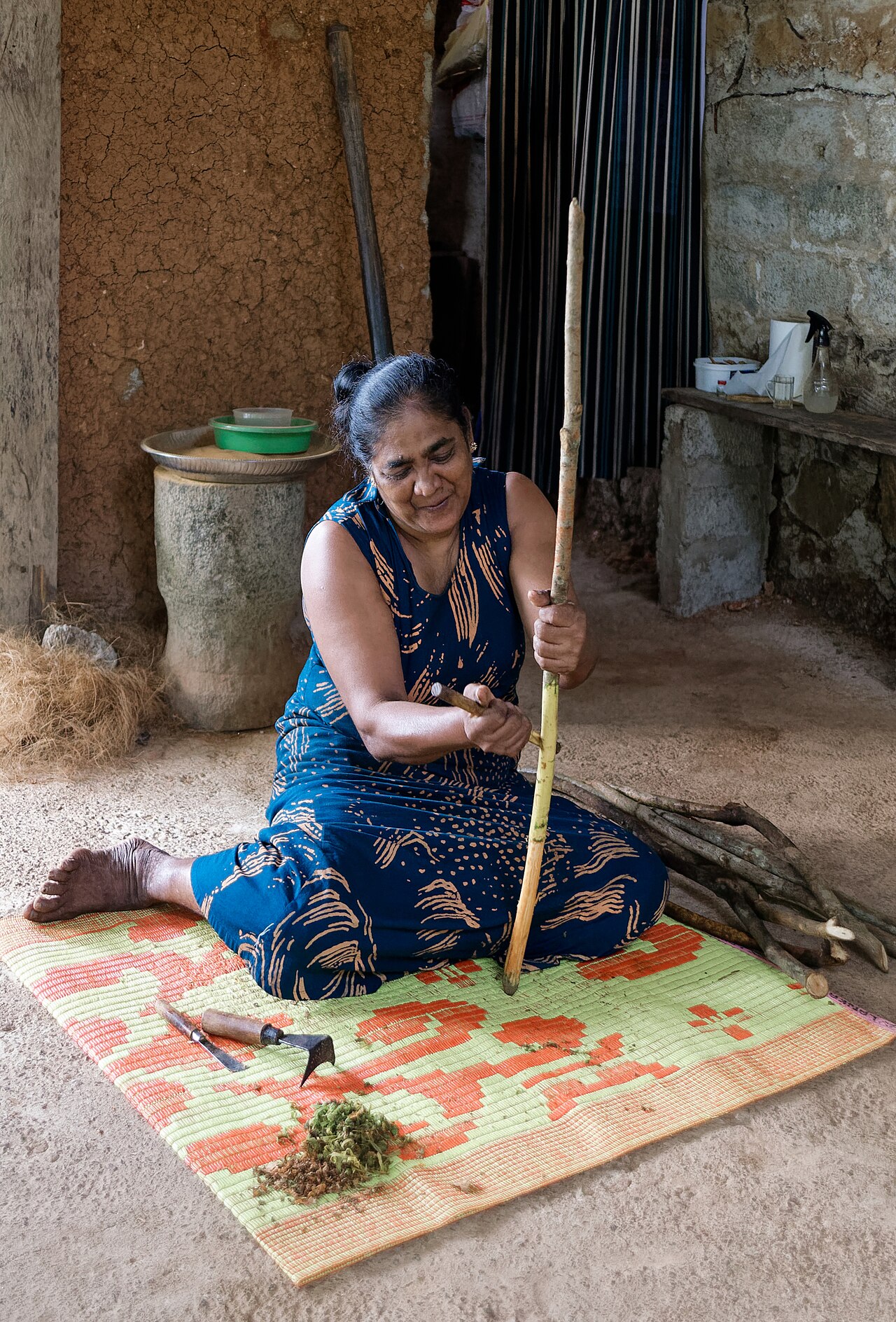
Peeling cinnamon by hand, Balapitiya
Cinnamomum verum
True cinnamon කුරුඳු
Real cinnamon is native to this island and almost nowhere else, and most of what is sold as cinnamon abroad is cassia, a thicker, hotter cousin. The true quill is rolled by hand from tissue-thin layers of inner bark — a peeler’s craft that runs in families along the south-west coast around Balapitiya. Snap a quill: true cinnamon shatters like a cigar, cassia cracks like a stick.
Buy quills, not powder · look for pale, papery, many-layered
The rack
The rest of the shelf
Black pepper was the island’s heat for two thousand years before the Portuguese brought chilli. Cloves, nutmeg and mace grow around Kandy, cardamom in the cool of the Knuckles, and no curry starts without curry leaves and rampe — pandan — hitting hot oil first.
A town grocery sells all of it at local prices
Technique
Roasted or raw
Sinhala cooking runs on two curry powders: raw, pale and coriander-led for vegetables and fish, and dark-roasted — toasted until it smells almost of coffee — for meat and the deepest dishes. The sours are their own shelf: goraka for fish, tamarind in the north, lime everywhere.
That black pork curry? Roasted powder is the secret
Fair warning
The spice garden trap
The “spice gardens” lining the Kandy–Matale road offer a free tour that ends in a hard sell at ten times the grocery price, with some miracle cures thrown in. Go for the garden if you enjoy the theatre; buy your spices in a town shop, or from the peeler in Balapitiya.
If the tour is free, you are the harvest
What to hold
Tea, palm and pink.
Ceylon tea is the export; king coconut, arrack and lurid pink faluda are what people actually drink.
Tea
Ceylon, by elevation
High-grown from Nuwara Eliya is light and brisk, mid-grown from Dimbula fuller, low-grown from Ruhuna dark and strong. Locally it is served hot, sweet and often with milk powder rather than milk.
Coconut
Thambili
The orange king coconut, cut open at a roadside stall. Rehydration that costs almost nothing and tastes better than anything bottled.
Palm
Toddy and arrack
Sap tapped from coconut or kithul palms, fermented into toddy or distilled into arrack. Old coconut arrack with soda and lime is the island’s drink.
Soft
Ginger beer & faluda
Elephant House ginger beer is a genuinely good local institution; faluda is rose syrup, milk, basil seeds and ice cream, sold in bright pink glasses.
Note
Poya days are dry
Alcohol is not sold on full-moon days and some other holidays. Bars in tourist hotels sometimes find a way; do not count on it.
Water
Bottled or filtered
Tap water is treated in cities but not worth the risk on a short trip. Refill from filtered stations where you can rather than buying a case of plastic.
Eating well
Five things worth knowing.
None of this is enforced on visitors. All of it is noticed and appreciated.
Hands
Right hand only
Mix with the fingertips, not the palm, and push with the thumb. A spoon is always available and nobody minds — but the food genuinely tastes different eaten properly.
Heat
“Less spicy” is relative
Say it once, expect it to still be hot, and keep curd or a plain rice nearby. Milk beats water.
Refills
The bowls come back
Emptying a bowl is a request for more. If you are finished, leave a little.
Vegetarians
Easily fed, with one catch
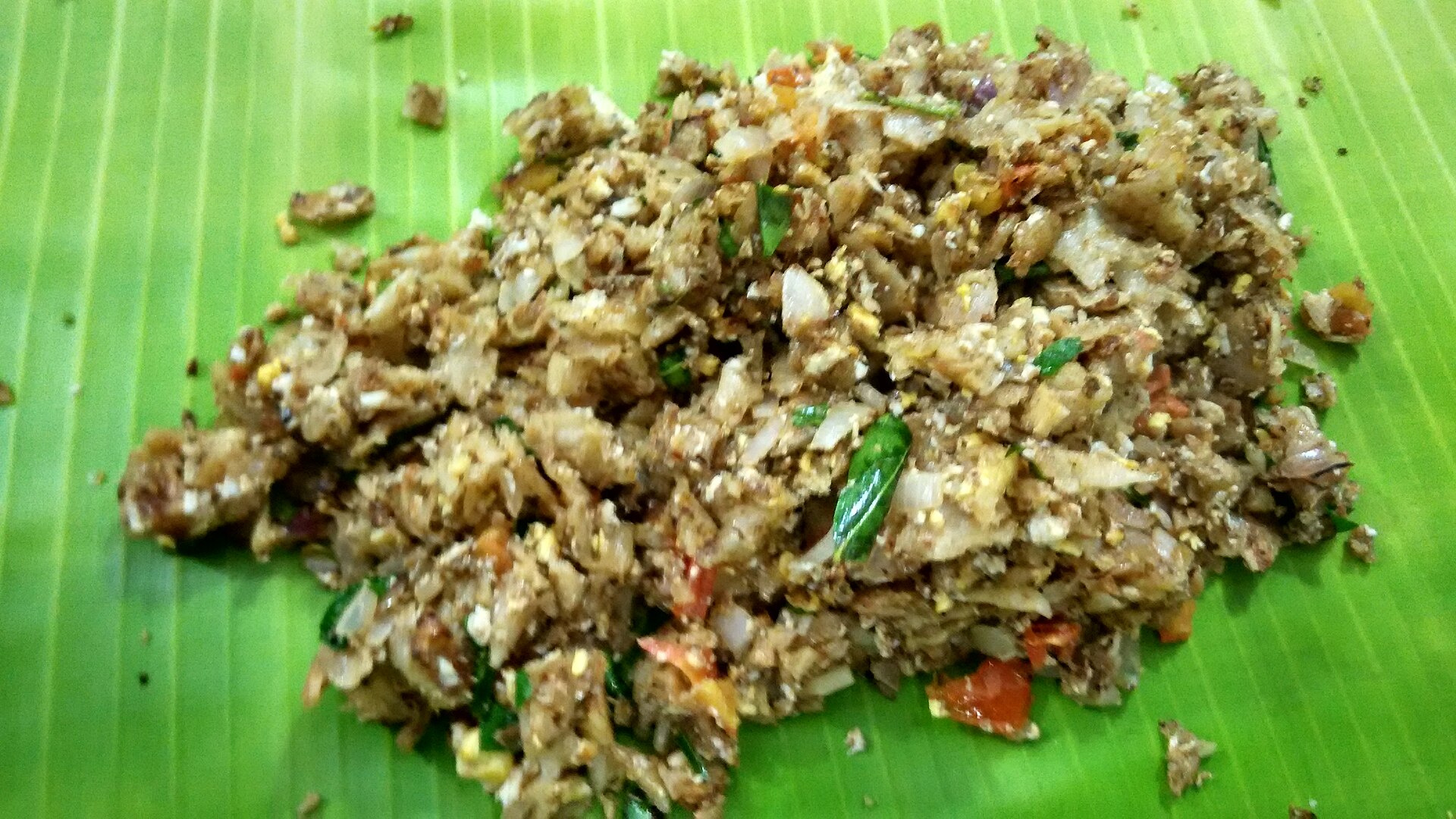
Most curries are vegetable-based, but Maldive fish — dried and shredded — is sprinkled into sambols and dhal by default. Ask for it without.
Where
The word is “hotel”
A place called a hotel on a small-town sign is usually a restaurant. The unmarked ones with a rice-and-curry board out front are the good ones.